How to Count Sober Days: Day One, Resets and Milestones
Counting days is one of the simplest tools people use when they stop or take a break from drinking. A number like 23 is concrete. It gives you something to protect on a difficult evening and something to notice on a good one.
The counting itself sounds trivial, but questions come up quickly. Is the day you stopped day one or day zero? What happens to the number after a slip? Is it better to count on a calendar, in a spreadsheet or in an app? This guide answers those questions, shows how to calculate the number yourself, and explains how to keep the count in NoAlco if you prefer not to do the arithmetic.
Before you start
This article is about keeping a count, not about health or treatment. If you have been drinking heavily or every day for a long time, stopping suddenly can be risky, so speak to a doctor or another healthcare professional before you stop. If you are worried about your drinking, the support section at the end of this guide lists places to start.
Which day is day one?
There is no single official rule, and different groups and people count slightly differently. The two common conventions are:
- Count from the first full day without a drink. If your last drink was on a Monday evening, Tuesday is day one. This is how many people count, because the number then means "full days completed".
- Count from the moment of your last drink. Monday evening is the start, and the count becomes 1 day once 24 hours have passed. This is how a timer or an app clock counts.
Both are fine. What matters is that you pick one and stay with it, so the number means the same thing every time you look at it. Write the start date down somewhere you will not lose it.
How to calculate your number of sober days
On a calendar
The simplest method is to mark each completed day on a paper calendar. You never have to calculate anything, and the row of marks is satisfying to look at. The drawback is that a calendar is easy to forget at home, and counting marks across several months gets slow.
By subtracting dates
To get the number directly, subtract the start date from today's date. Within one month it is easy: from 3 March to 20 March is 17 days. Across months, add the days left in the first month to the days so far in the current month, plus the full months in between. From 20 January to 5 March in a non-leap year is 11 days left in January, 28 in February and 5 in March, so 44 days.
Whether you then add one depends on your convention. If day one is the first full day, and that day was 21 January, the count on 5 March is 5 March minus 21 January plus one, which is also 44. Decide once and you will not have to think about it again.
In a spreadsheet
Put your start date in a cell, for example A1, and in another cell type =TODAY()-A1. Format the result as a number rather than a date. The figure updates every time you open the file. You can add a second column of dates and notes if you want a simple log.
In an app
A counter app does the subtraction for you, keeps running in hours and minutes between days, and usually adds milestones. The trade-off is that your records live in that app, so it is worth knowing where they are stored and whether they can be deleted.
Milestones worth marking
Milestones break a long goal into reachable pieces. Commonly marked points include:
- The first 24 hours and the first 3 days.
- One week and two weeks.
- One month, which is also the length of a dry month challenge.
- 100 days, a round number many people like to aim for.
- Six months and one year.
Plan something small and alcohol-free for each one: a meal out, a new book, a day trip, or simply telling someone who supports you. Marking the milestone makes it real, and it gives you something to look forward to between them.
What to do after a slip
Many people who stop drinking have a slip at some point. How you treat the count afterwards is your choice. Some people restart from zero; others keep a separate total of alcohol-free days alongside the current run. Either way, the days you already managed still happened.
A reset is useful information rather than a verdict. Note what was going on that day: the time, the place, who you were with and how you felt. Over a few weeks, patterns such as end-of-week stress or particular social situations tend to show, and you can plan for them next time. If you keep finding it hard to stop despite wanting to, that is a good moment to talk to a professional rather than to try harder alone.
Calendar, spreadsheet or app?
- Paper calendar: no technology, very visible, but stays in one place and needs counting by hand.
- Notes or spreadsheet: free and flexible, updates itself with a formula, but has no reminders or milestones unless you build them.
- Counter app: always with you, counts automatically and shows milestones, but you depend on the app and should check how it stores your data.
There is no wrong answer. Plenty of people use a counter for the number and a paper journal for their thoughts.
How to count sober days in NoAlco
NoAlco is a simple sobriety counter that runs in your browser or on your phone:
- Open NoAlco and go through the short welcome screens.
- Choose Start Today if you are beginning now, or Start from Past Date if you stopped earlier and want the count to include those days.
- Enter roughly what you used to spend on drinks per day. NoAlco uses this to show an estimate of the money not spent on alcohol.
- Look at Home: it shows your alcohol-free time in days, hours, minutes and seconds, and how far you are from the next milestone.
- Open Stats to see your current streak, your best streak, the number of attempts and a bar chart comparing the current run with your best. Tap the badges to see the collection, from day 1 through 3 days, 1 week, 2 weeks, 1 month, 100 days, 6 months and 1 year.
- Use the Calendar tab to write a short note for today or an earlier day. Days inside your current run are highlighted.
- If you slip, use the reset icon on Home. After you confirm, the counter starts again from zero, your best record is kept and the attempt count goes up by one.
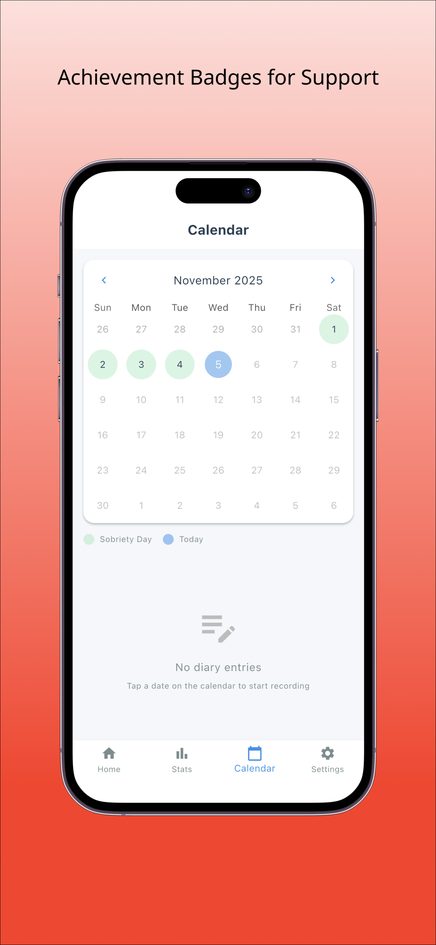
The start date and daily cost can be changed later in Settings. The web version keeps records only in your browser. The iPhone and Android apps add daily reminder notifications.
Where to find support
A counter is a self-tracking tool, not a treatment. If you are concerned about your drinking, or find you cannot stop when you want to, these are reasonable first steps:
- Talk to your doctor or another healthcare professional, especially before stopping if you drink heavily.
- In the United States, the SAMHSA National Helpline (1-800-662-4357) is free, confidential and open 24 hours, and FindTreatment.gov lists services near you.
- In the UK, the NHS lists alcohol support services, including Drinkline, the national alcohol helpline.
- Mutual-help groups such as Alcoholics Anonymous and SMART Recovery hold meetings in many countries, in person and online.
If you are in another country, your doctor or a local health service can point you to the right help.
Frequently asked questions
Is the day I stopped day one or day zero?
Either convention works. Many people count the first full day without a drink as day one; a timer counts from the moment of the last drink. Pick one and keep using it.
How do I calculate days sober in Excel or Google Sheets?
Enter your start date in one cell, for example A1, then type =TODAY()-A1 in another cell and format it as a number. Add one if you count the start day itself as day one.
Can I start NoAlco from a date in the past?
Yes. Choose Start from Past Date during setup, or change the start date later in Settings.
Does a reset delete my history in NoAlco?
No. The current counter goes back to zero, but your best streak is kept, the attempt count increases and your diary entries stay.
Can NoAlco tell me whether I have a drinking problem?
No. It only records the dates and notes you enter. For questions about your health or your drinking, talk to a doctor or a qualified professional.