How to Decide Who Goes First in a Board Game (12 Fair Ways)
Going first can matter a lot in some games and hardly at all in others, but the question comes up at the start of every game night. A quick, fair method saves arguments and gets everyone playing sooner.
This guide starts with the most important rule, checking the rule book, then lists fair and fun ways to choose a starting player, how to set the order for everyone else, and how to keep things balanced over a session. It ends with how to pick a starting player with a spinning wheel in Roulette.
First, check the rule book
Many games specify how to choose the first player, and some deliberately balance the advantage of going first. Chess gives white the first move; many modern board games name a quirky rule, such as the person who most recently did something related to the game's theme; others give later players extra resources to make up for going after the first player. If the rules say how to choose, follow them. The methods below are for games that leave it to the players.
Fair ways to decide who goes first
Chance-based methods
- Roll a die each; the highest roll starts. Re-roll ties between the tied players only.
- Flip a coin for two players.
- Draw cards from a shuffled deck; the highest card starts. Agree whether aces are high before drawing.
- Draw lots: write names on slips of paper, fold them, and pull one from a cup or hat.
- Draw straws: one shorter straw among equal ones, held so nobody can see.
- Spin a decision wheel with every player's name on it.
Rule-of-thumb methods
- The youngest player goes first. A friendly choice in family games.
- The newest player to the game goes first, so they can get into it straight away.
- Whoever lost the last game goes first.
- The host goes last as a courtesy, and the player to their left starts.
- Rock, paper, scissors for two players.
- A themed rule you invent for the game, in the spirit of the playful rules found in many rule books.
Setting the order for everyone else
Once the first player is chosen, most games continue clockwise around the table. That is simple and needs no further decision. If your group sits in a way that makes clockwise awkward, or you are playing remotely, you can set a full order instead:
- Spin or draw once for the first player, then once more for second place from the remaining names, and so on.
- Roll dice for everyone and go from highest to lowest.
- Write the order down, especially in online or long games, so nobody has to remember it.
Balancing first-player advantage over a session
If you play several games in a row, rotate the first player rather than choosing randomly each time, so everyone gets a turn. In a single competitive game where going first is a real advantage, consider the official variants some games offer, such as extra starting resources for later players, or agree that the last player gets a small bonus.
Dice, cards, paper slips or a wheel?
Dice and cards
Usually already on the table, quick and trusted by everyone. Ties need a re-roll or re-draw, which can drag on with a big group.
Paper slips or straws
Fair, no ties, and easy to pull several names in a row for a full order. You need paper and a pen, and it is less exciting to watch.
Youngest player or other house rules
Instant and friendly, but predictable. The same person tends to start every time unless you rotate.
Spinning wheel
No ties, works for any number of players, and everyone watches the same spin, which adds a bit of drama at the start of the game. You need a phone or computer to hand.
How to pick who goes first with Roulette
Roulette works well for choosing the first player:
- Tap the round gear button in the lower-right corner to open the item editor.
- Type each player's name into a field. Use Add Item for more players, or the bin icon to remove empty slots.
- Press Save.
- Put the phone in the middle of the table and press SPIN.
- The name under the pointer at the top goes first, and it is shown below the wheel.
- For a full turn order, remove the chosen name in the editor and spin again for second place, and so on.
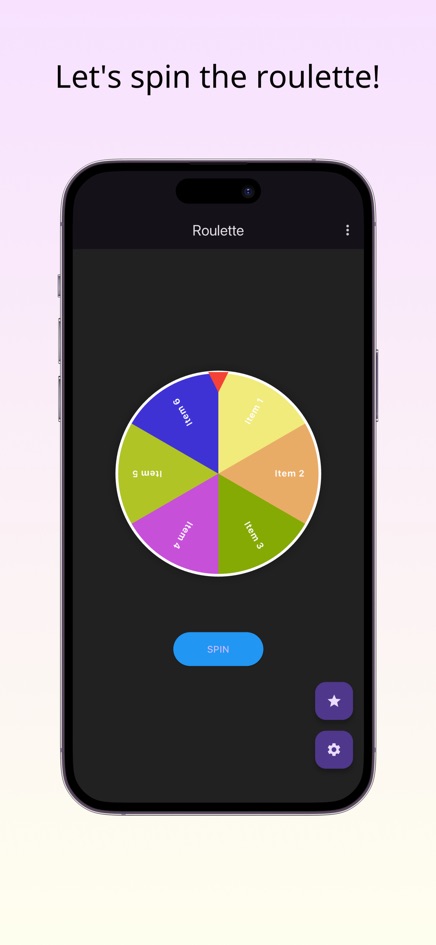
Each name gets an equal-sized slice, so every player has the same chance. Roulette is for games and everyday choices, with no betting or money. It works in the browser and on iPhone and Android. For other uses, see how to make a decision wheel.
Frequently asked questions
What is the fairest way to decide who goes first?
Any method where every player has the same chance: rolling dice, drawing lots, drawing cards or spinning a wheel with each name on it. Over several games, rotating the first player is fairest of all.
Who goes first in chess?
White always moves first. Players often decide who plays white by hiding a pawn of each colour in their hands and letting the other player choose a hand.
Is going first an advantage?
In some games yes, in others it makes little difference, and some games compensate later players. Check the rule book for any balancing rules.
How do we decide turn order for a large group?
Pick the first player, then go clockwise. If you need a full random order, draw names one at a time or spin a wheel and remove each chosen name.
Does Roulette remember our player names?
In the web version, names stay while the page is open but are cleared when you reload or close it.