Best Time to Weigh Yourself (and How Often) for Consistent Numbers
If you have ever stepped on a scale twice in one day and seen two different numbers, you already know the problem: the time and the conditions of a weigh-in change the result. To compare readings from one day or week to the next, the conditions need to be as similar as possible.
This guide covers the time of day most people find gives the most consistent readings, how to set up the scale, how often to weigh yourself, and how to read the numbers as a trend. It compares paper, spreadsheet and app records and ends with how to keep a log in WeightLog. It is about measuring and recording, not about what your weight should be.
Before you start
This article is general information, not medical advice, and it does not suggest any weight, goal or rate of change. If you are tracking your weight because of a health condition, follow the instructions of your doctor or care team. If thinking about weight or food is causing you distress, a doctor or other qualified professional can help.
The most consistent time: first thing in the morning
Many people choose to weigh themselves in the morning, after using the toilet and before eating or drinking. The reason is consistency rather than any special accuracy. By morning, the previous day's meals and drinks have mostly been processed, and you have not added today's yet, so conditions are similar from day to day.
Later in the day, a reading includes whatever you have eaten and drunk, which is why evening weights are often higher. That does not make them wrong; it just makes them hard to compare with morning ones. If mornings do not suit you, pick another fixed point, such as before your evening shower, and keep to it.
A simple weigh-in routine
- Put the scale on a hard, flat floor such as tiles or wood. Carpets and uneven floors can make readings unreliable.
- Leave the scale in the same spot. If you have to move it, some digital scales recalibrate better if you tap them once and wait for zero before stepping on.
- Weigh at the same time of day, after the toilet and before eating or drinking if you choose mornings.
- Wear the same thing each time, or nothing.
- Stand still in the middle of the scale with your weight evenly on both feet until the reading settles.
- Write the number down straight away, in the same unit each time.
How often should you weigh yourself?
There is no single right answer, and different people do well with different approaches:
- Daily: gives the smoothest trend because one odd day matters less among many readings. It suits people who can see a higher number without worrying about it.
- Once or twice a week: fewer numbers to think about. Use the same day and conditions each week, because each reading carries more weight.
- Less often, or not at all: perfectly reasonable if weighing causes stress or is not useful for you. Weight is only one measure of health.
If a doctor has asked you to weigh at a certain frequency, for example because of a medical condition, follow their instructions.
Read the trend, not the day
Body weight naturally moves up and down from day to day, for reasons such as fluid, salt and the timing of meals (see why your weight fluctuates). Instead of reacting to one reading, look at the direction over several weeks. A handy check is to compare the average of the first week of a month with the average of the last week.
Notebook, spreadsheet, smart scale or app?
Notebook or printable log
Easy and private. Spotting a trend means drawing your own graph or calculating averages by hand.
Spreadsheet
Calculates averages and draws charts automatically. It is less convenient to update from the bathroom each morning.
Smart scale
Sends readings to an app automatically, which removes typing. It usually needs an account and an app from the scale maker, and the extra measurements some scales show are estimates.
Simple logging app
Works with any scale. You type one number, and the app keeps the calendar and graph. It only knows what you enter.
Keeping a weight log in WeightLog
WeightLog is a minimal weight diary with a calendar and a graph, and nothing else: no goals, targets or BMI.
- Open WeightLog. The first time, read the short notice explaining that it is a record-keeping tool, not a medical device.
- After your weigh-in, tap today's date on the calendar.
- Type your weight, with decimals if you like, such as 68.4, and tap Save. Use the same unit every time.
- Look at the line graph under the calendar to see the month's entries.
- Use the arrows to move between months. Tap a day with a value to change it, or clear the field and save to remove it.
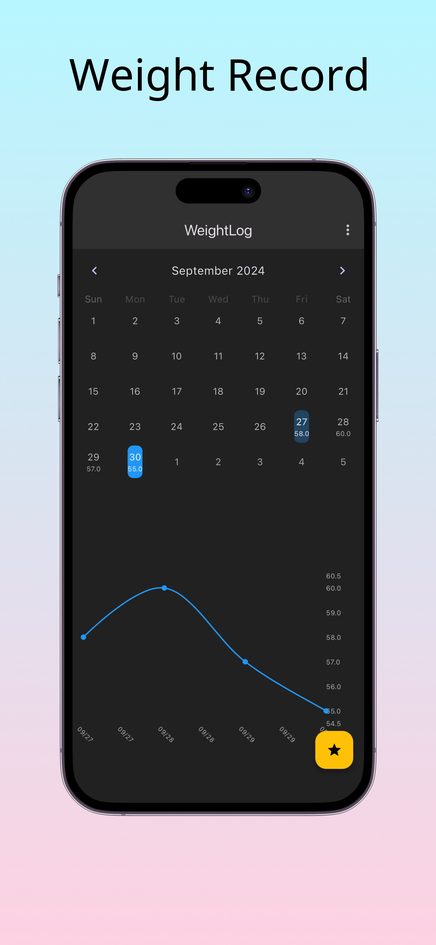
WeightLog is also available for iPhone and Android.
Frequently asked questions
Is it better to weigh yourself in the morning or at night?
Neither is more correct, but mornings after the toilet and before eating are the easiest conditions to repeat. Whatever you choose, keep to the same time.
Should I weigh myself every day?
Daily weighing gives a smoother trend if you focus on the direction over weeks. If daily numbers cause worry, weighing weekly or less often is fine.
Why do two scales give different readings?
Scales differ slightly in calibration. Use the same scale for your log so readings are comparable.
Does WeightLog tell me what I should weigh?
No. It records your numbers and shows them on a calendar and graph. Ask a doctor or other qualified professional if you want advice about weight.
Where are my entries stored?
In the web version, only in your browser on that device, with no account. Clearing browser data removes them, and they do not sync with the phone apps.