DoughLog - Sourdough Journal


DoughLog is a journal for sourdough bakers and the starters they keep alive. You register each starter with its hydration and flour blend, then log every feeding: the starter-to-flour-to-water ratio, the flours used, the water amount, the room temperature, when it peaked, how active it looked and how it smelled. A photo of the jar can go with each entry.
A starter is a living culture, and its behaviour changes with temperature, flour and feeding rhythm. Writing things down is the most reliable way to understand why it doubled in four hours last week and barely moved today. DoughLog also includes the everyday baking calculators you reach for while mixing dough, and a simple recipe planner that walks you through each step of a bake.
It works in the browser without an account. Starters, feedings, recipes and photos are saved on your device.
The app runs entirely in your browser. What you enter is saved only on this device.
How to use DoughLog
- Create a starter. On the Starters tab tap New, give the starter a name, set its hydration percentage, choose its flour blend (white, whole wheat, rye, spelt, einkorn, emmer, buckwheat, gluten-free or custom) and add notes about its origin. No starter yet? Open the 7-day from-scratch guide.
- Log a feeding. Tap Log Feeding and pick a ratio such as 1:1:1 or 1:5:5, the flour portions and the water amount. Add the room temperature and a photo if you like.
- Record how it behaved. Later, edit the feeding to note when it peaked, an activity level from Dead to Very Active and a smell note like yogurty, vinegary or acetone.
- Check the Today screen. Today shows each starter and how long ago it was last fed, so you can see at a glance which one needs attention.
- Use the calculators. In Tools, open the hydration calculator, baker's percentage calculator, feeding ratio calculator or unit converter while you plan or mix a dough.
- Plan and run a recipe. In Recipes, list steps such as autolyse, mix, bulk fermentation, shape, proof and bake with their durations, then run the recipe to follow each step with its own timer.
- Look back in the Journal. The Journal lists recent feedings across all starters so you can compare rhythms and spot patterns.
Features
- Starters with hydration, flour blend, status and notes (two starters on the web)
- Feeding log with ratio, flours, water, temperature, peak time, activity, smell and photo
- 7-day guide for creating a starter from scratch
- Today screen showing how long since each starter was fed
- Hydration, baker's percentage and feeding ratio calculators
- Unit converter for grams, ounces, cups and temperature
- Recipe planner with step timers (three recipes on the web)
- Journal of the last 30 days of feedings
- Data and photos saved in the browser, no account
Sourdough starter basics: feeding, hydration and reading the signs
What a starter is
A sourdough starter is a mix of flour and water colonised by wild yeasts and lactic acid bacteria. The yeasts produce gas that raises bread; the bacteria produce acids that give sourdough its tang and help it keep. Regular feedings with fresh flour and water keep both populations healthy.
Understanding feeding ratios
Ratios are written starter : flour : water by weight. A 1:1:1 feeding mixes equal weights of each, for example 50 g starter, 50 g flour and 50 g water. Bigger ratios such as 1:5:5 dilute the existing culture more, so the starter takes longer to peak. Bakers use larger ratios in warm weather or when they want the starter ready the next morning instead of in a few hours.
Hydration and baker's percentage
Hydration is the weight of water divided by the weight of flour, as a percentage. A starter fed equal weights of flour and water is at 100% hydration, which gives a thick batter. Lower hydration makes a stiffer starter that ferments more slowly.
Baker's percentage expresses every ingredient relative to the total flour, which is counted as 100%. A dough with 1,000 g flour, 750 g water, 20 g salt and 200 g starter is 75% water, 2% salt and 20% starter. Writing recipes this way makes them easy to scale up or down. Remember that the flour and water inside the starter also count towards a dough's true hydration.
Reading activity and peak
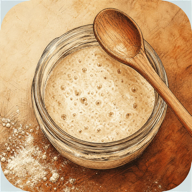
After feeding, a healthy starter rises, becomes domed and full of bubbles, then reaches a peak and begins to fall. Many bakers use it at or just before the peak, when it is most active. A starter that doubles in four to eight hours at room temperature is generally considered lively. Warmth speeds everything up; a cool kitchen slows it down, which is why logging temperature alongside the peak time is so useful.
What the smell tells you
A mild yogurt or fruity smell usually means a well-fed starter. A sharp vinegar note suggests more acetic acid, often from a stiffer starter or a cool spell. A nail-polish or acetone smell commonly appears when a starter is hungry and overdue for a feeding. Grey liquid on top, called hooch, is another sign of hunger and can be poured off or stirred in.
Pink, orange or fuzzy growth is different: those are signs of spoilage, and the usual advice is to discard the starter rather than try to rescue it.
Frequently asked questions
Where are my starters and photos stored?
In this browser's local storage on this device. There is no account and nothing is uploaded. Clearing your browser data or using a private window removes everything, so stick to one browser.
Will DoughLog remind me to feed my starter?
Not on the web, because a closed browser tab cannot deliver notifications. The Today screen shows how long ago each starter was fed. The iPhone and Android apps can send feeding reminders.
How many starters and recipes can I keep?
The web version holds two starters and three recipes, and the Journal shows the last 30 days.
What does the phone app add?
The iPhone and Android apps can unlock unlimited starters and recipes, more photos per feeding, a bulk fermentation predictor, a bake-time scheduler, a levain builder, activity graphs over time, and PDF, JSON and CSV export.
Which ratio should I start with?
1:1:1 is a common starting point for a room-temperature starter. If it peaks too quickly for your schedule, try 1:2:2 or higher and note the result in your log.
Can I use cups instead of grams?
Grams give the most consistent results, but the unit converter can translate between grams, ounces and cups, and temperatures between Celsius and Fahrenheit.
Limitations of the web version
- No feeding reminders on the web
- Two starters, three recipes and a 30-day journal view on the web
- Fermentation predictor, bake scheduler, levain builder, charts and export are not available on the web
- Data does not sync across browsers or devices
Disclaimer
General baking information only. If a starter shows mould or unusual colours, discard it; when in doubt about food safety, don't eat it.
Phone app
DoughLog is also available as an app for phones and tablets: