How to Measure a Fish: Length, Weight and Girth the Right Way
Measuring a fish sounds simple until you try it on a wet boat with a fish that will not lie still. Small differences in method, such as pinching the tail or not, or measuring along the curve of the body, can change the number by a few centimetres, which is enough to decide whether a fish is legal to keep or a new personal best.
This guide covers the standard ways to measure length, how to weigh a fish accurately, how to estimate weight when you have no scale, and how to handle the fish quickly if you plan to release it. It finishes with tips for recording the numbers so they stay comparable over the years.
What you need
- A measuring board, sometimes called a bump board: a flat ruler with a stop at one end. A flexible tape works but is less accurate on a curved fish.
- A digital or spring scale, plus a wet landing net or weigh sling.
- A soft tape measure if you want girth.
- Water to wet your hands and the board.
Total length, fork length and standard length
There are three common ways to measure the length of a fish, and they give different numbers:
- Total length: from the tip of the snout to the tip of the tail. This is what most anglers mean by length, and it is used in many size limits.
- Fork length: from the tip of the snout to the fork in the middle of the tail. It is used for species with deeply forked tails, such as many tunas and some other sea fish.
- Standard length: from the snout to the end of the last vertebra, at the base of the tail. Mostly used in science.
Size limits differ between regions and species, and some specify fork length or a particular way of handling the tail. If you plan to keep fish, check the current rules where you fish rather than relying on a general guide.
How to measure total length
- Wet the board and your hands so you protect the fish's slime coat.
- Lay the fish flat on its side on the board, with its mouth closed and its snout pushed gently against the stop.
- Keep the body straight. Do not measure along the curve of the back with a tape; that adds length.
- Gently pinch the tail lobes together, or follow the method your local rules specify, and read the measurement at the tip of the tail.
- Read the number straight down from above, not at an angle.
Taking a photo of the fish on the board, with the number visible, is a good habit. It confirms the measurement later, and it is how many catch-and-release tournaments verify a fish.
How to weigh a fish
- Zero the scale with the wet net or sling hanging from it, or weigh the empty net afterwards and subtract it.
- Place the fish in the net or sling rather than hanging it by the jaw or gills, which can injure it.
- Lift, let the reading settle for a second, and note it.
- Return the fish to the water quickly if releasing.
Spring scales lose accuracy over time. Check yours occasionally against a known weight, such as a bag of sugar.
Estimating weight from length and girth
If you have no scale, measure the girth (around the body at its widest point, usually just in front of the dorsal fin) as well as the length. A widely quoted rule of thumb is:
Weight in pounds ≈ length in inches × girth in inches × girth in inches ÷ 800
For a fish 20 inches long with a 12-inch girth, that is 20 × 12 × 12 ÷ 800 = 3.6 lb. Treat the result as a rough estimate: body shape varies by species and season, and anglers use different divisors for different fish. Record it as estimated, so you do not mix it up with weighed catches later.
If you are releasing the fish
- Have the board, scale and camera ready before you land the fish.
- Keep air time short. Measure first, then weigh only if it is quick.
- Support the body horizontally; avoid squeezing.
- Hold the fish in the water facing into the current until it swims off under its own power.
Comparing ways to keep the numbers
A tape on a phone photo alone is quick but easy to misread later. A notebook works, but the number is separated from the photo and conditions. A spreadsheet is good for comparing, but entry at the water is slow. An app that keeps length, weight, photo and conditions in one record is the simplest way to keep personal bests honest, as long as you always measure the same way.
Recording length and weight in Fishing Log
In Fishing Log:
- Choose metric or imperial units in Settings once, so every record uses the same units.
- Tap the add button, type the species, and enter the length and weight.
- Add the spot, weather, water temperature, lure or bait and tackle.
- Attach the photo of the fish on the board, and note in the memo if the weight was estimated or the fish was released.
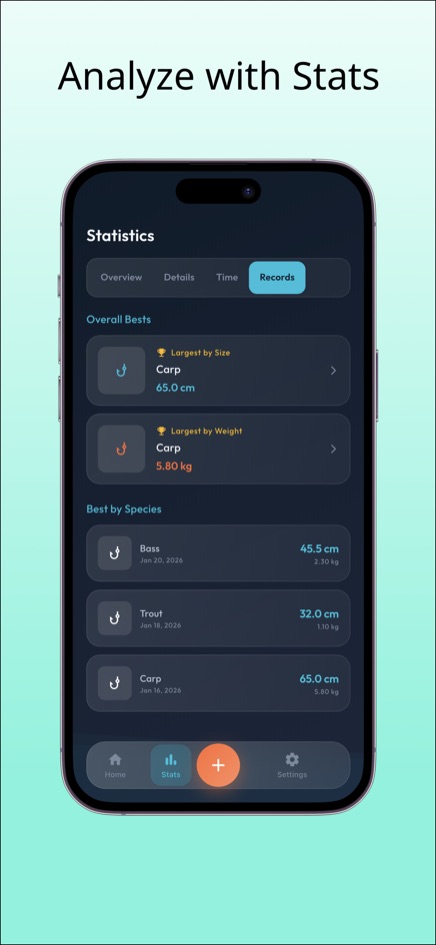
Personal bests by size and weight are part of the detailed statistics in the iPhone and Android apps. The free web version records length and weight and shows a monthly chart and species breakdown.
Frequently asked questions
Should I pinch the tail when measuring?
Many anglers and many size rules measure total length with the tail lobes pinched together, but not all do. Follow the rules where you fish, and use the same method every time for your own records.
Is measuring along the curve of the body accurate?
No. It adds length. Measure flat and straight on a board for comparable numbers.
How accurate is the girth formula?
It is only an estimate. It works reasonably for typically shaped fish but can be well off for very thin or very heavy-bodied ones. Weigh the fish when you can.
Can Fishing Log show sizes in inches and pounds?
Yes. Switch between metric and imperial in Settings in the web version or the phone app.