How to Measure Height at Home Accurately (for Kids and Adults)
Measuring height at home is easy to do badly. Shoes, hair, a slouch, a soft carpet or a tape held at an angle can each add or remove a centimetre or more, which is a lot when you are comparing one measurement with the last.
This guide shows a simple, repeatable method using things most homes already have, with extra tips for measuring a child and for measuring yourself without help. It covers common mistakes, how often to measure, and the honest pros and cons of a wall and tape, phone apps and a doctor's measurement. It ends with how to keep a height log in GROW.
Before you start
This article is about measuring and record keeping only. It is not medical advice and does not say how tall anyone should be or how fast they should grow. Doctors and nurses assess children's growth using proper equipment and growth charts. If you have any concern about your own or your child's growth or health, talk to a doctor or other qualified health professional.
What you need
- A flat, hard floor without carpet or a rug, next to a wall with no skirting board in the way, or a door frame.
- A flat object with a right angle, such as a hardback book, a box or a carpenter's square.
- A pencil or a removable sticky note to mark the wall.
- A metal tape measure, which stays straighter than a fabric one.
- A helper if possible.
Step by step
- Remove shoes, thick socks, hats and hair accessories. Undo ponytails or buns that sit on top of the head.
- Stand with your back to the wall, feet flat and together, heels touching the wall.
- Let the back of the head, shoulder blades, buttocks and heels touch the wall if they naturally can. Not everyone's body allows all of them to touch; that is fine.
- Look straight ahead with the chin level, as if looking at the horizon, not up or down.
- Breathe in and stand tall without lifting the heels.
- Your helper places the book flat on the top of the head, pressed against the wall at a right angle, firmly enough to flatten hair.
- Mark the wall at the underside of the book, then step away.
- Measure from the floor to the mark with the tape held straight. Read it to the nearest millimetre or eighth of an inch.
- Repeat once or twice. If the readings differ, use the average of two that agree closely.
- Write down the result with the date, the time of day and the unit straight away.
Measuring a child, or measuring yourself
Measuring a child
Turn it into a quick routine: same wall, same time of day, same book. Kneel so your eyes are level with the book when you read the mark, which avoids reading it too high or too low. Young children find it hard to stand still, so gently hold the heels against the wall or make it a game of standing like a soldier for three seconds. For babies and toddlers who cannot stand, length is measured lying down, and that is best left to a health visitor or doctor.
Measuring yourself
Stand against the wall and place the book on your head, then hold it firmly against the wall as you carefully duck out from under it. Mark the underside and measure. A mirror in front of you helps keep the book level. It is harder to be precise alone, so take a few measurements and average them.
Common mistakes
- Measuring at different times of day. Most people are slightly taller in the morning, because the discs in the spine compress during the day. Pick a time and keep to it.
- Measuring on carpet or with shoes on.
- Tilting the book, which makes the mark too high.
- Letting the tape sag or start from the wrong end of its metal hook.
- Comparing measurements from different methods, such as a home measurement with a reading from a clinic. Small differences between methods are normal.
How often to measure
Height changes slowly, so weekly measurements mostly record measuring error. For children, every one to three months is plenty to see a trend. For adults, an occasional check is enough. A log with dates is more useful than pencil marks alone, because it shows the time between measurements.
Wall and tape, phone app or doctor?
Wall, book and tape measure
Cheap and, done carefully, consistent. Its accuracy depends entirely on technique, which is why the steps above matter.
Door-frame marks or a growth chart sticker
A lovely family record, but the marks need dates and a tape measure to become numbers you can compare.
Phone measuring apps
Augmented-reality measuring apps are convenient, but results can vary with lighting, angle and the phone, so they are better for a rough check than for tracking small changes.
Doctor's or nurse's measurement
Clinics use a stadiometer, a fixed vertical ruler with a sliding headpiece, and plot children's measurements on growth charts. This is the measurement that matters for any health question.
Keeping a height log in GROW
GROW keeps your measurements in one place and shows them as a graph. It records what you enter; it cannot change how tall anyone will become.
- On first launch, set up a profile with birthday, sex and current height.
- After each measurement, open the record tab and choose height.
- Enter the value in 0.1 cm steps, or in feet and inches where those units are used, and save. GROW shows the change since your last entry.
- Open the graph tab to see height by month or by year, and growth this month and this year.
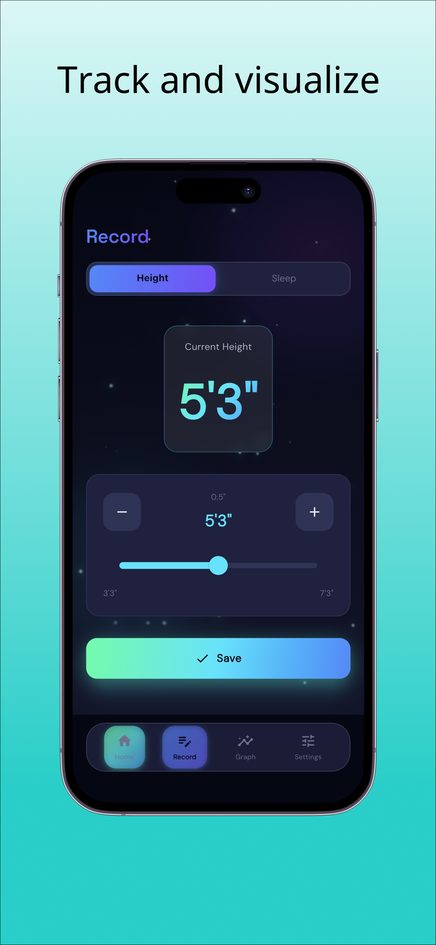
GROW also has a daily checklist of everyday habits such as sleep, activity and posture. The iPhone and Android apps can send reminders. Any predicted height shown in the app is a rough statistical estimate from parents' heights, not a forecast; a doctor's assessment always takes priority.
Frequently asked questions
Why am I shorter in the evening?
The discs between the vertebrae compress slightly during the day while you are upright and recover overnight, so most people measure a little taller in the morning. Measure at the same time of day each time.
Can I measure height without a tape measure?
You can mark the wall and measure later with a ruler, a known-length object or a tape borrowed from someone else. For tracking changes, an actual tape measure or ruler gives the most consistent numbers.
Is a home measurement accurate enough for a doctor?
It is fine for your own records. For any health question, a doctor or nurse will measure again with their own equipment.
Can GROW make my child taller?
No. No app or habit can promise extra height. GROW is a record-keeping and habit tool; talk to a doctor about any growth concerns.
Where does GROW store measurements?
In the web version, only in your browser on that device, with no account. Clearing browser data removes them, and they do not sync with the phone apps.