7v7 Soccer Formations: 2-3-1, 3-2-1 and 3-1-2 Explained
Seven-a-side soccer is played with a goalkeeper and six outfield players on a smaller pitch. Many youth programmes use it for younger age groups, and plenty of adult recreational leagues play it too. With only six outfield players, every position matters, and the shape you choose has a big effect on how the game feels.
This guide explains how to read 7v7 formation numbers, then walks through the three most common shapes, 2-3-1, 3-2-1 and 3-1-2, with their strengths, weaknesses and the kind of team each suits. It ends with tips for choosing a shape, a comparison of ways to plan your lineup, and how to set one up and share it in KickOff.
How to read 7v7 formation numbers
Formation numbers list the outfield players from the back to the front, leaving out the goalkeeper. In 7v7 the numbers always add up to six. A 2-3-1 has two defenders, three midfielders and one forward; a 3-2-1 has three defenders, two midfielders and one forward.
The numbers describe a starting shape, not fixed lanes. In small-sided games players move between lines constantly, and the shape mostly tells each player where to return to when the team loses the ball.
2-3-1: the balanced default
Two defenders sit either side of the goal, three midfielders spread across the middle, and one forward leads the line. It is the most common 7v7 shape for a reason: it gives width through the two wide midfielders and a clear passing triangle in every part of the pitch.
- Strengths: balanced, easy to explain, gives the wide midfielders room to attack and the central midfielder a link role.
- Weaknesses: only two defenders, so the wide midfielders must track back. A fast opposing forward can isolate a defender.
- Suits: teams with energetic wide players and a central midfielder who reads the game.
3-2-1: solid at the back
Three defenders, two central midfielders and a lone forward. The back three cover the width of a small pitch, which makes the team hard to break down.
- Strengths: secure defensively, good for building play from the goalkeeper, and the two outside defenders can step forward when the team has the ball.
- Weaknesses: the forward can be isolated if the midfield does not push up, and the two midfielders have a lot of ground to cover.
- Suits: teams that concede too many goals, newer players who benefit from clear defensive roles, or matches against stronger opponents.
3-1-2: two up front
Three defenders, one central midfielder and two forwards. It puts more players near the opponent's goal while keeping three at the back.
- Strengths: two forwards can combine and press the opponent's defenders, and the back three provide cover.
- Weaknesses: the single midfielder is easily outnumbered, so the forwards and outside defenders need to help in midfield.
- Suits: teams with two forwards who work well together and a fit, disciplined central midfielder.
How to choose a shape for your team
- Start from your players. Count who is reliable in defence, who has the energy to cover the flanks, and who likes to score. The best formation is the one your available players can carry out.
- Check attendance before match day. A shape that depends on two forwards does not work if only one turns up.
- Keep it simple for younger players. One shape used consistently teaches more than a different one every week.
- Rotate positions in youth teams. Many coaches move children through defence, midfield and attack across a season so they learn the whole game.
- Have a plan B. Decide in advance how you will switch, for example from 2-3-1 to 3-2-1 when protecting a lead.
- Check your league's rules. Youth 7v7 formats often have their own rules on match length, substitutions, build-out lines and retreat lines.
Whiteboard, paper or app?
Magnetic tactics board or whiteboard
Great at training and at half time, because players can see and move the pieces. It stays at the pitch, though, so it does not help you share the lineup before the game.
Paper team sheet
Quick and familiar. It gets messy as players drop out, and a photo of handwriting in a group chat is not always easy to read.
Drawing or image apps
Can produce a tidy graphic, but every change means redrawing, and they know nothing about your squad or who is available.
A team manager app
Combines the squad list, attendance and formation in one place, so you can build the lineup from players who are actually coming and share it as an image. It takes a few minutes to enter your squad the first time.
How to set up a 7v7 lineup in KickOff
KickOff has formations for 11-a-side, 7-a-side and 5-a-side. For a 7v7 lineup:
- In the Team tab, add each player with a name, shirt number, main position, an optional second position and preferred foot.
- Create the match with the date, opponent, home or away and location, and mark each player as attending, maybe or absent. Set all attending fills in the whole squad at once.
- Open the Lineup tab and create a formation. Give it a name, such as "2-3-1 vs City", and choose 7-a-side.
- Pick a template: 2-3-1, 3-2-1 or 3-1-2. For 5-a-side, 2-2, 1-2-1 and 2-1-1 are available; for 11-a-side, shapes such as 4-4-2, 4-3-3 and 4-2-3-1.
- Place players from Available Players into positions on the pitch. Everyone you do not place stays on the bench.
- Save the formation and share it as an image to post in your team chat. In the web version this downloads a PNG file.
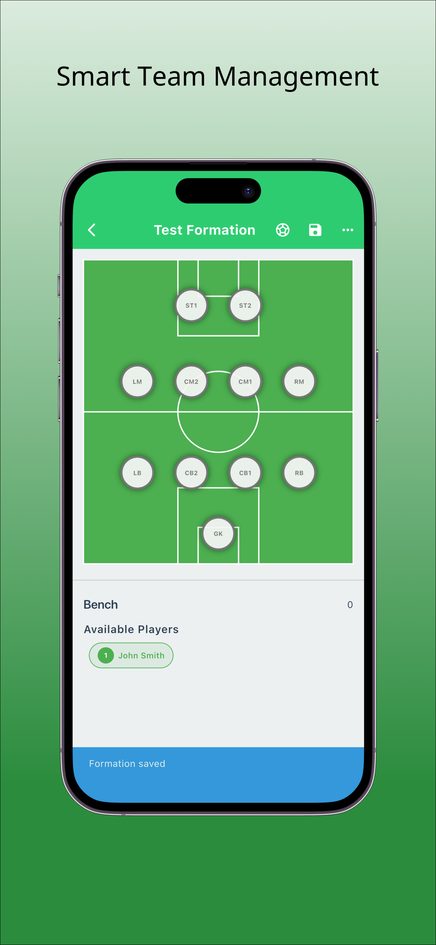
KickOff is also available for iPhone and Android. To record the match itself, see how to keep soccer stats.
Frequently asked questions
What is the best 7v7 formation?
There is no single best one. 2-3-1 is the most common balanced choice; 3-2-1 is more defensive and 3-1-2 more attacking. Choose based on the players you have available.
How many players are on the field in 7v7 soccer?
Seven per team: a goalkeeper and six outfield players. Formation numbers describe the six outfield players.
What does 2-3-1 mean?
Two defenders, three midfielders and one forward, plus the goalkeeper.
Does KickOff support 5-a-side and 9v9?
KickOff has 11-a-side, 7-a-side and 5-a-side formations. 9v9 is not a separate option.
Where is my team data stored in the web version?
Only in your browser on your device, with no account. Manage the team from one browser, because data does not sync between devices.