How to Make a Mind Map for an Essay and Turn It into an Outline
The hardest part of writing an essay is often the part before writing: deciding what you actually think and in what order to say it. A mind map helps because it lets you get every idea down first, in any order, and then see which ones belong together.
This guide shows how to go from an essay question to a mind map to a paragraph-by-paragraph outline, with a worked example. It also covers when a mind map is not the best tool and how to do the whole process in an app.
Step 1: Put the question in the center
Write the essay question or topic in the middle, in short form. Throughout this guide we will use an example: Should schools start later in the morning? If the prompt is long, reduce it to the core issue, but keep any instruction words such as compare, evaluate or argue in mind, because they decide what kind of branches you need.
Step 2: Brainstorm without sorting
For five to ten minutes, add every idea that comes to mind as a branch from the center: arguments, facts you remember, examples, objections, questions, even half-formed thoughts. Do not judge them yet. For the example, that might give: teen sleep, bus schedules, after-school jobs, sports practice, attendance, test scores, parents' work hours, research I have read about, cost.
Quantity matters more than quality at this stage. A weak idea often leads to a strong one on the next branch.
Step 3: Group ideas into main branches
Now look for clusters. Which ideas are really about the same thing? In the example, three groups appear:
- Health and learning: teen sleep, attendance, test scores.
- Practical problems: bus schedules, cost, parents' work hours.
- Life outside school: after-school jobs, sports practice.
These groups become your main branches. Ideas that do not fit any group are often the ones to drop, which is one of the most useful things a map does: it makes leaving things out a visible choice.
Step 4: Decide your position
Look at the branches together and decide what you are going to argue. Which side has more substance? Which objections can you answer? Your thesis might be: Schools should start later because the benefits to sleep and learning outweigh the scheduling problems, which can be managed. Write the thesis near the center or as a note, so every branch can be checked against it.
Step 5: Add evidence to each branch
Under each main branch, add the specific support you will use: a statistic from a source, a quotation, an example, a case. Note the source on the node so you can cite it later. A branch with no evidence is a warning sign; either research it or reduce its role in the essay.
Add a branch for the strongest counterargument, with your response beneath it. Essays that acknowledge the other side and answer it are usually more convincing than ones that ignore it.
Step 6: Turn the map into an outline
A finished map converts almost directly into a plan:
- Introduction: the question, brief context, and your thesis.
- One body paragraph (or section) per main branch. Order them so the strongest argument comes first or last, and so each leads naturally into the next.
- Within each paragraph, the sub-branches become the points and evidence, in the order that builds the argument.
- A paragraph for the counterargument and your response.
- Conclusion: return to the thesis and say why it matters.
For the example essay: introduction, health and learning, life outside school, practical problems as the counterargument with solutions, conclusion. Write the outline as a numbered list next to the map, then start drafting.
When a mind map is not the best tool
If you already know your argument and its order, a plain outline is faster. For a short answer of one or two paragraphs, a list of points is enough. Mind maps earn their keep for longer essays, open questions and topics where you do not yet know what you think. Some writers also find a map useful after a first draft, to check whether the structure holds together.
Paper or an app?
Paper works well for the brainstorm, but grouping is awkward: you cannot move ideas, so you end up drawing arrows or redrawing the whole map. Sticky notes on a desk solve that, at the cost of portability. An app lets the brainstorm grow without running out of space and keeps the map with you while you draft. Check whether your app lets you drag nodes; if not, regroup by deleting an idea and adding it again under the right branch.
Planning an essay in MindMap
In MindMap:
- Edit the central node and type the essay question.
- Brainstorm by tapping the center and adding a node for each idea.
- Save this as a brainstorm map, then reset and build a clean map with your main branches. Add each idea under its branch; nodes are positioned automatically.
- Add evidence nodes under each branch, and use node colors to mark, for example, evidence in one color and counterarguments in another.
- Pick a theme from the palette button; Monochrome is easy to read when you are concentrating on text.
- Save the map with the essay's title, and keep it open next to your draft.
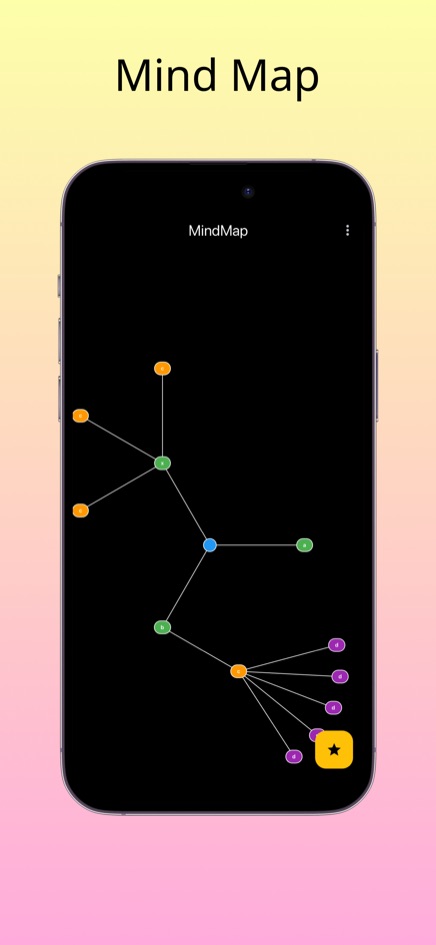
MindMap is free on the web and available for iPhone and Android. It does not export to outline or document formats, so type the outline from the map yourself.
Frequently asked questions
How long should I spend on the mind map?
For a typical school or college essay, 15 to 30 minutes is plenty. The goal is a clear structure, not a work of art.
Can I use a mind map in a timed exam?
Yes, a quick sketch of the question and three or four branches in the first few minutes can save time later by preventing a disorganized answer.
Should each branch be one paragraph?
Often, but not always. A large branch may need two paragraphs, and two small related branches may share one.
Does MindMap need an account?
No. The web version saves maps in your browser on your device, and the phone apps keep them on your phone.