How to Convert Blood Glucose from mg/dL to mmol/L (and Back)
Blood glucose is reported in two different units around the world. The United States and some other countries use milligrams per decilitre (mg/dL), while the UK, Canada, Australia and many others use millimoles per litre (mmol/L). If you move country, read information written for another country, or have a meter set to a different unit from your clinic, you will need to convert.
The conversion itself is simple arithmetic. This guide shows the formula, worked examples, how to round, where the number 18 comes from, and how to avoid mixing units in your records.
A note before the numbers
This article explains unit conversion only. It is not medical advice, and the example numbers below are arbitrary round values chosen to make the arithmetic easy to follow, not targets or ranges. Your doctor or care team will tell you which ranges apply to you, in the unit they use. Follow their guidance, and ask them if you are unsure how to read your meter.
The conversion formula
For glucose, the conversion factor is approximately 18:
- mg/dL to mmol/L: divide by 18.
- mmol/L to mg/dL: multiply by 18.
Some references use 18.0 and some use 18.016. The difference is tiny and disappears when you round to the precision meters normally display: whole numbers for mg/dL and one decimal place for mmol/L.
This factor is specific to glucose. Other blood tests reported in both units, such as cholesterol, triglycerides or creatinine, use different factors, so do not reuse 18 for them.
Worked examples
mg/dL to mmol/L
- Take the reading in mg/dL, for example 144.
- Divide by 18: 144 ÷ 18 = 8.0.
- Round to one decimal place: 8.0 mmol/L.
Another example: 81 mg/dL ÷ 18 = 4.5 mmol/L.
mmol/L to mg/dL
- Take the reading in mmol/L, for example 7.5.
- Multiply by 18: 7.5 × 18 = 135.
- Round to a whole number: 135 mg/dL.
Another example: 8.2 mmol/L × 18 = 147.6, which rounds to 148 mg/dL.
Quick mental check
mmol/L numbers are always much smaller than mg/dL numbers, roughly one eighteenth. If a converted value is larger in mmol/L than it was in mg/dL, you multiplied when you should have divided.
Why the factor is about 18
The two units measure different things. mg/dL is a mass: milligrams of glucose in a decilitre (one tenth of a litre) of blood. mmol/L is an amount of substance: millimoles of glucose in a litre.
One mole of glucose weighs about 180 grams, so one millimole weighs about 180 milligrams. A concentration of 1 mmol/L is therefore 180 mg in a litre, which is 18 mg in a decilitre. That is why 1 mmol/L equals about 18 mg/dL.
Rounding and keeping one unit in your records
Converting back and forth can introduce small rounding differences. 136 mg/dL becomes 7.6 mmol/L, and 7.6 mmol/L converts back to 137 mg/dL. These differences are not meaningful, but they can be confusing in a log. Some practical habits:
- Record readings in the unit your meter shows, exactly as displayed. Do not convert before writing them down.
- Use one unit for your whole log, so charts and averages compare like with like.
- If your meter's unit differs from what your clinic uses, ask your care team which they prefer, and whether the meter can be set to that unit. Do not change meter settings without checking the manufacturer's instructions.
- When you read guidance written for another country, convert their numbers, not your own records.
- Label every number with its unit when you share it, so nobody has to guess.
Mental math, a calculator, a chart or an app?
Mental math
Dividing by 18 in your head is hard; dividing by 20 and adjusting up a little gives a rough idea, but it is not precise enough to write down.
Calculator
The phone calculator is the most reliable way to convert a single reading: type the number, then ÷ 18 or × 18.
Printed conversion chart
Handy if you convert often, since you can read the value off a table. Make sure it is a glucose chart and that it comes from a trustworthy source.
Logging app
A log app that works in your meter's unit avoids conversion altogether for day-to-day records. SugarLog lets you choose the unit but does not convert readings between units.
How units work in SugarLog
In SugarLog, the unit is a setting rather than a converter:
- Before your first entry, open Settings and choose mg/dL or mmol/L under Unit, matching your meter.
- Tap Add Record and type the value exactly as the meter shows it, with the date, time and timing.
- Charts and Statistics (average, highest, lowest, standard deviation and count) are shown for your records, overall and per timing.
- If you change the unit later, new readings use the new unit, but each saved reading keeps the unit it was entered in. Older readings are not converted, so it is best to pick the right unit at the start.
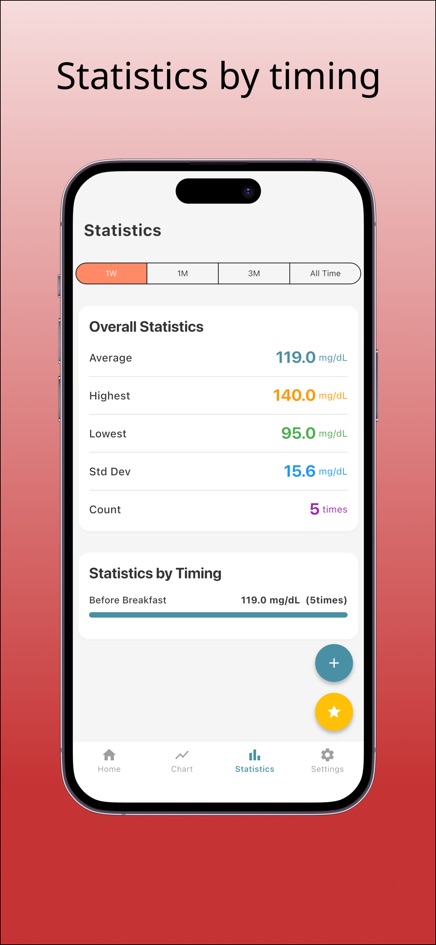
SugarLog is a record-keeping tool, not a medical device. Get it on iPhone or Android, and see our guide on how to keep a blood sugar log.
Frequently asked questions
How do I convert mg/dL to mmol/L for glucose?
Divide the mg/dL value by 18 and round to one decimal place. For example, 90 mg/dL ÷ 18 = 5.0 mmol/L.
How do I convert mmol/L to mg/dL for glucose?
Multiply the mmol/L value by 18 and round to a whole number. For example, 5.0 mmol/L × 18 = 90 mg/dL.
Is the factor 18 or 18.016?
Both are used. The difference is too small to matter once you round to the precision meters display.
Can I use 18 for cholesterol too?
No. The factor 18 applies to glucose only. Cholesterol, triglycerides and other tests use different factors.
Which unit should I use?
Use the unit your meter shows and your care team uses. If they differ, ask your care team which they prefer.
Does SugarLog convert my old readings when I switch units?
No. Each reading keeps the unit it was entered in, so choose your unit before you start logging.