How to Calculate Peptide Reconstitution: Concentration, Volume and Syringe Units
Reconstitution means dissolving a powder that comes in a vial with a measured amount of liquid, usually bacteriostatic water. Once it is dissolved, the question becomes a math problem: how much liquid holds a given amount, and where does that volume land on the scale of the syringe you are using?
The arithmetic is short, but it mixes milligrams, micrograms, millilitres and syringe units, and a single slipped decimal point changes the answer tenfold. This guide explains the calculation in three steps, shows worked examples with round numbers, compares doing it by hand, with a chart or with a calculator, and lists the checks that catch most mistakes.
Read this first
This article explains arithmetic only. It is not medical advice and it does not recommend any substance, amount or schedule. If a medicine has been prescribed for you, follow the instructions from your prescriber and pharmacist, and ask them to check your numbers and show you how to measure. The examples below use arbitrary round numbers chosen to make the math easy to follow.
The three numbers you need
Every reconstitution calculation starts from three inputs. Write them down before you calculate anything:
- The amount of substance in the vial, as printed on the label, for example 5 mg.
- The volume of liquid you add to the vial, for example 2 ml. Use the volume you actually added, not the one you meant to add.
- The target amount you want to measure out, which in real use comes from your prescriber or from your protocol, not from a calculator.
You also need to know which syringe you are reading. Insulin-style syringes are marked in units, and the most common scale, U-100, has 100 units in 1 ml. Our separate guide on how to read a U-100 syringe covers the scales in detail.
Step 1: Work out the concentration
Concentration is how much substance is in each millilitre of liquid. Divide the amount in the vial by the volume of liquid added:
Concentration = amount in vial ÷ volume of liquid
A 5 mg vial with 2 ml added gives 5 ÷ 2 = 2.5 mg per ml. Because 1 mg is 1,000 mcg, that is the same as 2,500 mcg per ml. Converting to micrograms early is a good habit when your target amount is written in mcg, because it removes one source of decimal-point errors.
Adding more liquid does not change how much substance is in the vial. It only spreads it out, so the concentration goes down and the same amount takes up more volume.
Step 2: Find the volume for your target amount
Divide the target amount by the concentration. Make sure both are in the same unit first:
Volume (ml) = target amount ÷ concentration
With the 2,500 mcg per ml example and an arbitrary target of 250 mcg, the volume is 250 ÷ 2,500 = 0.1 ml.
Step 3: Convert the volume to syringe units
Multiply the volume by the number of units per ml printed on your syringe:
Units = volume (ml) × units per ml
On a U-100 syringe, 0.1 ml × 100 = 10 units. On a U-40 syringe, the same 0.1 ml is 0.1 × 40 = 4 units. The liquid is identical; only the scale printed on the barrel differs, which is why you must know your syringe type.
A useful extra figure is the amount per unit: concentration ÷ units per ml. At 2,500 mcg per ml on a U-100 syringe, each unit carries 25 mcg. Once you know that, you can sanity-check any result in your head.
How the amount of water changes the result
Here is the same 5 mg vial mixed with different volumes, read on a U-100 syringe. Nothing here is a suggestion; it simply shows the relationship:
- 1 ml added: 5,000 mcg per ml, 50 mcg per unit.
- 2 ml added: 2,500 mcg per ml, 25 mcg per unit.
- 2.5 ml added: 2,000 mcg per ml, 20 mcg per unit.
- 3 ml added: about 1,667 mcg per ml, about 16.7 mcg per unit.
More liquid means fewer micrograms in each unit, so a given amount needs more units. That can make small amounts easier to read on the barrel, but it also means more volume per measurement. When the result is a fraction such as 16.7, rounding to the nearest marking introduces a small error, which is worth knowing about rather than ignoring.
By hand, with a chart, or with a calculator?
By hand
The three formulas above are all you need, and working through them once is the best way to understand what the numbers mean. The weak point is units: it is easy to divide milligrams by micrograms without noticing. Write the unit next to every number.
Reconstitution charts
Printed or online charts list pre-calculated results for common vial sizes and water volumes. They are quick, but they only cover the combinations someone chose to print, and it is easy to read across the wrong row or column. A chart also cannot tell you whether its author assumed the same syringe scale as yours.
Spreadsheet
A spreadsheet with the three formulas works well and can be reused. Test it against a hand calculation before trusting it, and lock the formula cells so a stray edit does not break them.
A dedicated calculator
A calculator built for this job does the conversions for you, shows the result in both ml and units, and reduces typing errors with fixed fields. It is still only as accurate as the numbers you enter.
How to do the calculation in VialCalc
VialCalc runs the three steps as you type and draws the result on a syringe:
- Open VialCalc and read and accept the first-run notice about research, educational and informational use.
- Choose Recon mode, then pick a preset or Custom.
- Enter the amount of powder in the vial in mg, and the volume of bacteriostatic water you added in ml.
- Enter your target amount and use the toggle to switch between mcg and mg.
- Select your syringe: U-100 in 1 ml, 0.5 ml or 0.3 ml, U-40 1 ml, or Custom with your own units per ml.
- Read the units to draw, the volume in ml, the amount per unit and how many draws of that size the vial holds. The syringe drawing shows where the fill line falls.
- Tap Save Protocol and name the setup if you will reuse the same numbers.
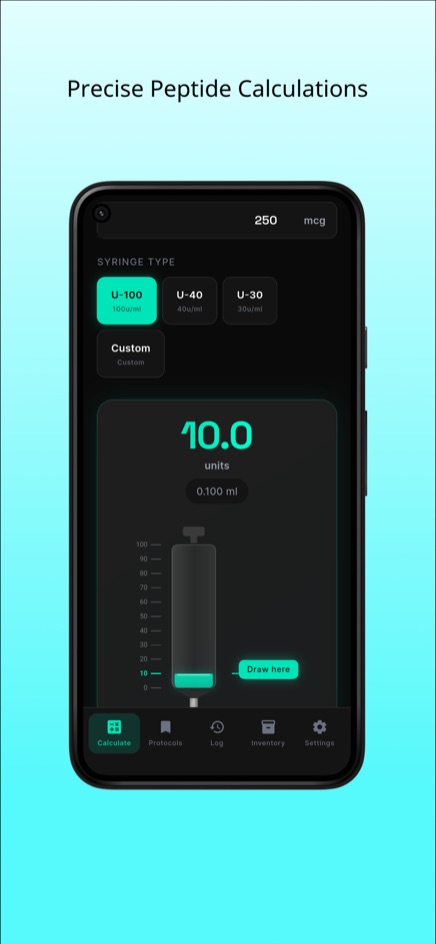
VialCalc does not suggest amounts, schedules or uses for any substance. The free web version and the Android app share the same calculator.
Checks that catch most mistakes
- Confirm the unit on the vial label. Some labels state mg, others mcg or IU, and a calculator cannot know which one you meant.
- Estimate before you calculate. If each unit carries about 25 mcg, a 250 mcg target should be about 10 units. A result of 1 or 100 means a decimal slipped.
- Check the syringe scale printed on the barrel. Reading a U-40 syringe as U-100 is off by a factor of 2.5.
- Make sure the result fits the barrel. A 0.3 ml U-100 syringe holds only 30 units.
- Have a pharmacist or prescriber check your figures for anything that will actually be used.
Frequently asked questions
Does this guide or VialCalc tell me how much to use?
No. Both only convert numbers you supply into concentration, volume and syringe units. Decisions about any substance or amount belong with your prescriber, pharmacist or another qualified professional.
Why does adding more water lower the concentration?
The amount of substance in the vial stays the same, but it is spread through more liquid, so each millilitre holds less. The same amount then takes up a larger volume and more syringe units.
What is the difference between mg and mcg?
1 mg (milligram) equals 1,000 mcg (micrograms). Mixing them up changes the result by a factor of 1,000, so convert everything to the same unit before dividing.
Can I use VialCalc without an account?
Yes. The web version runs in your browser and keeps saved protocols only on your device. VialCalc is also available for Android on Google Play.