How to Read a U-100 Syringe: Units to mL Explained
Insulin-style syringes are marked in units instead of millilitres, which confuses almost everyone the first time. A unit on the barrel is a measure of volume, and on the most common scale, U-100, the conversion is simple once you see it: 100 units fill 1 ml.
This guide explains what the U-100 label means, gives a units-to-mL conversion list, shows how the three common barrel sizes differ, explains why U-40 syringes cannot be read the same way, and covers the practical details of reading the plunger. It ends with how a calculator can show both scales side by side.
A note before you start
This is general measurement education, not medical advice. If you use a syringe for a prescribed medicine, follow the instructions from your prescriber and pharmacist, use the syringe type they specify, and ask them to show you how to measure. Never change an amount based on an article or an app.
What U-100 means
The U-100 scale was designed for insulin sold at a strength of 100 units per ml. The syringe is marked so that its unit lines match that strength: 100 units on the barrel equal exactly 1 ml of liquid. So one unit on a U-100 syringe is 0.01 ml, a hundredth of a millilitre.
The important consequence is that the unit marks only measure volume. For any liquid other than U-100 insulin, the number of units tells you how much liquid is in the barrel, not how much of a substance it contains. To know the amount, you need the concentration of the liquid, which is the subject of our guide on how to calculate reconstitution.
U-100 units to mL conversion
Because 1 unit is 0.01 ml, converting is a matter of moving the decimal point two places:
- 1 unit = 0.01 ml
- 5 units = 0.05 ml
- 10 units = 0.1 ml
- 20 units = 0.2 ml
- 25 units = 0.25 ml
- 30 units = 0.3 ml
- 50 units = 0.5 ml
- 100 units = 1 ml
To go the other way, multiply millilitres by 100: 0.15 ml is 15 units, 0.35 ml is 35 units. If you see 1 cc mentioned, it is the same volume as 1 ml.
0.3 ml, 0.5 ml and 1 ml barrels
U-100 syringes come in several sizes, and all of them use the same scale of 100 units per ml. The size only changes how much the barrel holds and how finely it is marked:
- 0.3 ml holds up to 30 units. The marks are spread out, commonly one line per unit, and some brands add half-unit marks. Best for small volumes.
- 0.5 ml holds up to 50 units, commonly with one line per unit.
- 1 ml holds up to 100 units, commonly with one line per two units, so odd numbers fall between lines.
Marking styles vary by brand, so look at your own barrel: find the numbered lines (often every 5 or 10 units) and count the small lines between them to work out what each small line is worth. The same volume reads as the same number of units on all three sizes; a smaller barrel just makes it easier to see.
Why U-40 syringes are different
U-40 syringes are marked for liquids at 40 units per ml, and are mostly seen in veterinary use. On a U-40 barrel, 40 units fill 1 ml, so each unit is 0.025 ml. The same 0.1 ml of liquid reads as 10 units on a U-100 syringe but only 4 units on a U-40 syringe.
Reading one type as if it were the other gives a volume that is wrong by a factor of 2.5. The scale is printed on the syringe and its packaging, and U-40 syringes are often made with a different cap color, though colors are not standardized everywhere. Always check the printed label rather than relying on color or memory.
Reading the plunger correctly
- Hold the syringe at eye level with the markings facing you, so you are not looking at the lines from an angle.
- Find the edge of the black rubber plunger seal that is closest to the needle. That flat edge is the line you read, not the far end of the seal or the tip of the cone.
- Line that edge up exactly with the mark you want.
- Check for air bubbles. A bubble takes up volume, so the liquid is less than the reading suggests. If you have been shown how to remove bubbles, do so and re-check the reading.
Good light helps more than people expect. The fine lines on a 1 ml barrel are hard to read in dim light, which is one reason smaller barrels are often used for small volumes.
Mental math, a printed chart, or a calculator
For U-100 alone, mental math is enough: move the decimal point two places. The difficulty starts when you combine it with a concentration to find units for a target amount, or when you switch to a U-40 or other scale. A printed conversion chart is handy beside the bench, but it covers one scale and cannot account for concentration. A calculator that handles all three steps and shows the result in both ml and units reduces the number of places a mistake can creep in, though you still need to enter the right numbers.
Seeing units and mL together in VialCalc
VialCalc shows every result in both forms and draws it on the barrel:
- Enter the vial amount, the water added and your target amount.
- In the syringe selector, choose U-100 1 ml, 0.5 ml or 0.3 ml, U-40 1 ml, or Custom and type the units per ml printed on a different syringe.
- Read the result as units and as ml, and look at the syringe drawing to see where the fill line falls on the barrel.
- If the result is larger than the barrel holds, switch to a larger size.
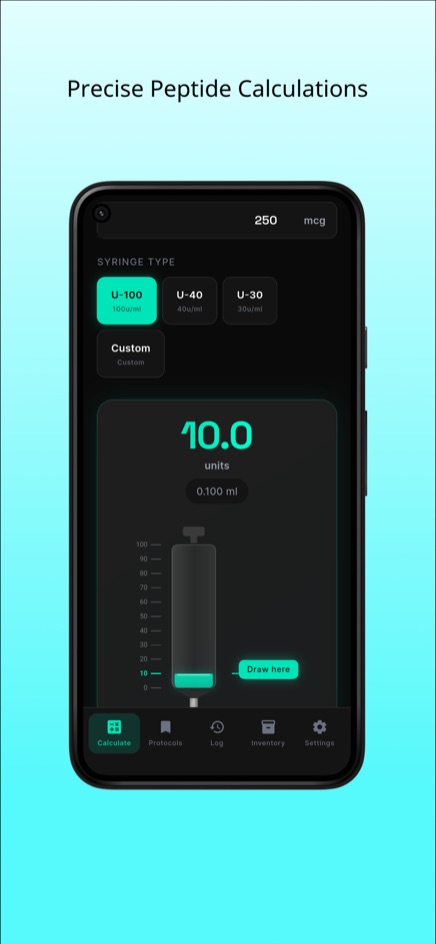
VialCalc is a math tool for research, educational and informational use. It does not recommend amounts. It is free on the web and available for Android on Google Play.
Frequently asked questions
How many units is 1 ml on a U-100 syringe?
100 units. Each unit is 0.01 ml, so 0.5 ml is 50 units and 0.1 ml is 10 units.
Is 10 units the same on a 0.3 ml and a 1 ml syringe?
Yes, if both are U-100. They share the same scale; the 0.3 ml barrel simply holds less and has more widely spaced lines.
Do units tell me how many mg are in the syringe?
No. Units on the barrel measure volume. The amount of a substance depends on the concentration of the liquid, so you need that figure as well.
Can I swap a U-40 syringe for a U-100 one?
Not without recalculating, because the scales differ by a factor of 2.5. Use the syringe type your prescriber, pharmacist or veterinarian specifies.