How to Keep Volleyball Stats: A Simple System for Coaches and Parents
Most volleyball teams know the final score of every match. Far fewer know why they won or lost it. A basic stats system answers questions the scoreboard cannot: who is scoring, where points are being given away, and which part of the game needs practice next week.
You do not need a video analyst. With a clear list of what to record and one or two volunteers, a coach, team manager or parent can keep useful stats in school, club and recreational volleyball. This guide covers which stats matter, how to calculate them, how to stay accurate during fast rallies, and the honest pros and cons of paper, spreadsheets and apps. It ends with how to do it in Voly.
Which volleyball stats to track
Start with a short list. These are the stats most coaches look at first, grouped by skill:
- Attacking: kills (attacks that score directly), attack errors (hit out, into the net or blocked for a point), and total attempts.
- Serving: aces (serves that score directly), service errors, and total serves.
- Blocking: block kills (blocks that score), and block errors such as net touches.
- Receiving: reception errors (serves your team could not keep in play), and optionally a quality rating for each pass.
- Defence and setting: digs (attacks kept off the floor) and assists or setting errors.
If you have only one helper, track kills, attack errors, aces, service errors and reception errors. Those five explain a large share of points in most matches.
The key calculations
Hitting percentage (attack efficiency)
The standard formula is (kills − errors) ÷ total attempts. A player with 10 kills, 4 errors and 30 attempts hits (10 − 4) ÷ 30 = 0.200, usually written .200. A hitter who scores often but also makes many errors gets little credit, which is the point: errors give the opponent free points.
Serving
Ace rate is aces ÷ total serves, and error rate is service errors ÷ total serves. Read them together. Aggressive serving produces both more aces and more errors, and the right balance depends on your team and the opponent.
Passing
Many coaches rate each serve receive on a 0 to 3 scale: 3 for a perfect pass that gives the setter every option, 2 for a playable pass with fewer options, 1 for a pass that barely stays in play, 0 for an error. The average rating is a quick measure of how well the team receives.
How to keep stats accurately during a match
- Agree definitions before the match. Does a ball blocked straight down count as an attack error? (Usually yes.) Write the definitions down so different volunteers record the same way.
- Give one person one job. The coach should watch the game, not a clipboard. If two helpers are available, split the work: one for attacking and blocking, one for serving and receiving.
- Record the score first, details second. If a rally is chaotic, make sure the point is recorded, then add the player detail if you saw it clearly.
- Use shirt numbers, not names. They are faster to write and easier to see across the court.
- Check the score with the official scorer at the end of each set, and fix any differences straight away.
- Review the numbers after the match, not during it, unless the coach asks for something specific at a timeout.
Expect the first few matches to be messy. Accuracy improves quickly once volunteers know the definitions and the shirt numbers.
Paper stat sheet, spreadsheet or app?
Paper stat sheet
A printable stat sheet with player numbers down the side and tally columns for each skill is cheap, reliable and needs no battery. Tallies are quick to mark. The downside is the work afterwards: someone has to add up every column and calculate percentages, and comparing matches over a season means a pile of paper.
Spreadsheet
A spreadsheet calculates hitting percentage and season totals automatically and is easy to share with the team. Typing during a live rally is hard, so most people tally on paper and enter the totals later, which doubles the effort.
Stats app
An app records each action with a tap and calculates percentages immediately, so stats are ready at the end of the match and saved for later. Tapping takes a little practice, and phones need charging. Some apps are built for professional video analysis; for school and club teams a simpler scorer is often enough.
How to keep volleyball stats in Voly
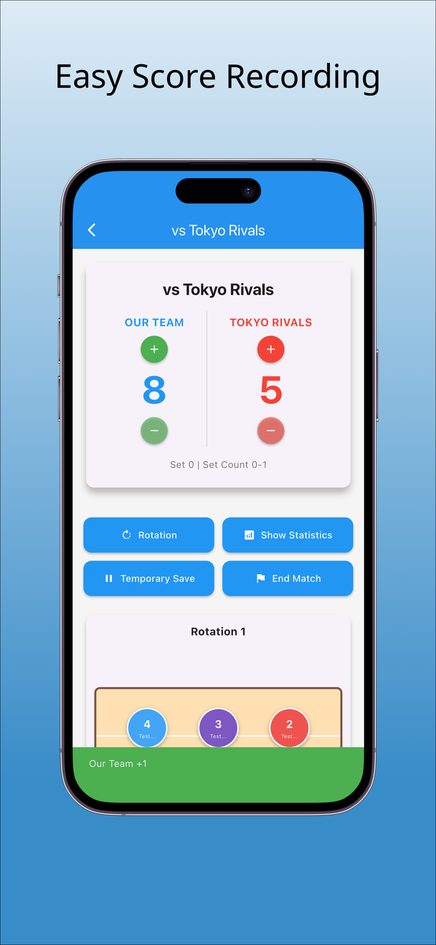
Voly combines the scoresheet and the stat sheet, so each point you record can also be credited to a player.
- Open Team Setup and add your players with name, shirt number and position. You need at least six to start a match.
- Build a starting lineup by placing players on the six court positions, then save it and mark it as the default.
- Tap New Match, enter the opponent and an optional venue, and choose the lineup.
- During each rally, use Our Team +1 or Opponent +1 for quick scoring. When you saw who won or lost the point, tap the player on the court and choose Point or Error, or open the details for actions such as spike kill, service ace, block kill or receive error.
- Tap Rotation whenever your team wins back the serve, so the court and the rotation stats stay correct. Use Undo Last or the −1 buttons to fix mistakes.
- Sets end automatically at 25 points (15 in the fifth set) with a two-point lead. Use Temporary Save if you need to pause.
- Open Show Statistics for attack efficiency, serve ace rate, block and receive success, setter distribution, rotation analysis and an efficiency-based MVP. Past matches stay in Match History.
The iPhone and Android apps store matches on the device. To understand the rotation side of the stats, see volleyball rotations explained.
Frequently asked questions
What is a good hitting percentage?
It depends heavily on level and position, so compare players within your own team and track each player's trend over the season rather than chasing a fixed number.
Does a blocked attack count as an attack error?
In the usual convention, an attack that is blocked for a point counts as an attack error for the hitter and a block kill for the blocker. Agree on your definitions before the match.
Can one person keep all the stats?
One person can keep a basic set: score plus kills, errors, aces and service errors. Detailed passing ratings and digs are easier with a second helper.
Does Voly record opponent player stats?
Opponent points are recorded as score only. Detailed player statistics are kept for your own team.
Where are Voly matches stored?
In the web version, only in your browser on that device, with no account. Clearing browser data deletes them, and they do not sync with the phone apps.