Volleyball Rotations Explained for Beginners (Plus 5-1, 6-2 and 4-2)
Rotation is the part of volleyball that confuses new players, parents and even new coaches the most. Players move around the court in a fixed order, some can attack at the net and some cannot, and a team can lose a point just for standing in the wrong place when the ball is served.
The rules are simpler than they look. This guide explains the six court positions, when and how teams rotate, the overlap rule, where the libero fits in, and the three most common systems: 5-1, 6-2 and 4-2. It compares ways to learn and track rotations and ends with how to follow them in Voly. Rules can vary slightly between competitions and age groups, so check your league's rules for details.
The six court positions
Each team has six players on court: three in the front row near the net and three in the back row. The positions are numbered 1 to 6, starting with the server and going anticlockwise as you look at your own side of the court from behind the baseline:
- Position 1: right back, the server
- Position 2: right front
- Position 3: middle front
- Position 4: left front
- Position 5: left back
- Position 6: middle back
These numbers describe where players stand when the ball is served. Once the serve is made, players can move to any spot, which is how teams get their specialists into their preferred positions.
When and how teams rotate
A team rotates only when it wins the right to serve back from the opponent, which is often called a side-out. Every player then moves one position clockwise: the player in position 2 moves to position 1 and serves, 1 moves to 6, 6 to 5, 5 to 4, 4 to 3 and 3 to 2.
If your team wins a rally while you are already serving, you do not rotate; the same player serves again. Because the order never changes during a set, the order written on the lineup sheet before the set decides who serves when and who spends time in the front row.
The overlap rule
At the moment the ball is served, players must be in the correct order relative to their neighbours. Under the common indoor rules:
- Each back-row player must be further from the net than the front-row player directly in front: 1 behind 2, 6 behind 3, 5 behind 4.
- Within each row, the left-right order must be kept: 4 to the left of 3, and 3 to the left of 2; 5 to the left of 6, and 6 to the left of 1.
- The server is not included once they are serving.
Being out of rotation or overlapping gives the opponent a point. Once the ball is served, the restriction ends and players move to their base positions. Some youth leagues relax overlap rules for beginners, so it is worth checking.
Front row, back row and the libero
Rotation matters because front-row and back-row players have different rights. Only front-row players may block or attack the ball from above net height in front of the attack line. Back-row players may attack only by jumping from behind the attack line.
The libero is a back-row specialist in a contrasting shirt who can replace back-row players without using a normal substitution. The libero cannot block, cannot attack from above net height, and in many competitions cannot serve. When the libero's player would rotate to the front row, the replaced player comes back on.
5-1, 6-2 and 4-2 systems
A rotation system describes how many hitters and setters a team uses. The first number is the hitters, the second is the setters.
5-1
One setter sets in all six rotations. For three rotations the setter is in the back row and the team has three front-row attackers. For the other three, the setter is in the front row, leaving two front-row attackers, although the setter can tip the ball over as an attacking option. Many competitive teams use a 5-1 because the hitters always work with the same setter.
6-2
Two setters stand opposite each other in the rotation, and whichever one is in the back row sets. That keeps three attackers in the front row in every rotation, at the cost of more substitutions and of hitters adjusting to two setters.
4-2
Two setters stand opposite each other, but whichever is in the front row sets. Only two front-row attackers are available, but it is simple to run and common in younger and recreational teams.
Ways to learn and track rotations
Paper diagrams
Drawing all six rotations on paper, with arrows showing where each player moves after the serve, is the classic coaching method. It is free and forces you to think through every rotation, but redrawing for every lineup change is tedious.
Magnetic or dry-erase board
A whiteboard with magnets is excellent for teaching players in practice and at timeouts. It does not remember anything, so it is not a record of what happened in a match.
Rotation tools and apps
Apps can store lineups, show the current rotation during a match and, if they also record points, show which rotations score well. They depend on someone tapping rotate at the right moment.
Following rotations in Voly
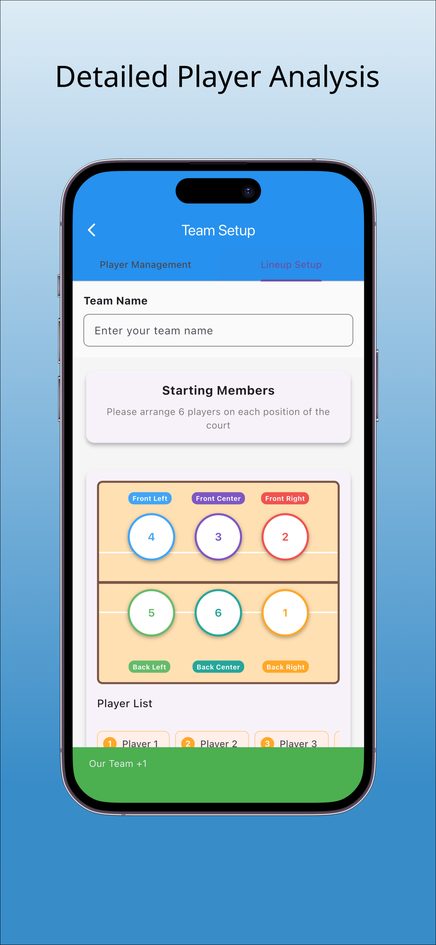
Voly shows your lineup on a court diagram with the six positions labelled from front left to back right.
- In Team Setup, add your players with their shirt numbers and positions.
- Open the lineup setup and place six players on the court positions. Save the lineup and make it the default if you use it most often.
- Start a match with that lineup. The court shows the current rotation.
- Each time your team wins back the serve, tap Rotation so the court moves to the next rotation. Voly does not rotate automatically, which keeps you in control if a rally is replayed.
- Record points and errors as usual. In Show Statistics, the rotation analysis shows how your team scored in each rotation, which helps you spot a weak rotation to practise.
Voly is also available for iPhone and Android. For the statistics side, see how to keep volleyball stats.
Frequently asked questions
Which way do players rotate in volleyball?
Clockwise. The player in right front (position 2) moves to right back (position 1) and serves.
Do you rotate when you win a point on your own serve?
No. You rotate only when you win the serve back from the other team. The same player keeps serving while your team keeps winning rallies.
What happens if a team is out of rotation?
The opponent is awarded a point and the positions are corrected. Officials may also cancel points scored while out of rotation, depending on the rules in use.
Does the libero rotate?
The libero replaces back-row players and leaves the court when their player rotates to the front row, so they never play in the front row.
Which system is best for beginners?
Many youth and recreational teams start with a 4-2 because it is simple to learn. Coaches move to a 5-1 or 6-2 as players specialise.