How to Draw Your Pet from a Photo: Step-by-Step Guide
A drawing of your own dog, cat or rabbit means more than almost any other subject, and it makes a lovely gift. It is also hard to get right freehand: if an eye or the nose is a few millimeters off, the drawing stops looking like your pet.
The good news is that the likeness comes mainly from the outline and the placement of the features, and you can get those right with a grid or by tracing. This guide covers choosing a photo, getting an accurate outline, and then the eyes, fur and shading that bring the drawing to life.
Step 1: Choose (or take) the right photo
The photo decides how easy the drawing will be. Look for these things:
- Sharp eyes. If the eyes are in focus, you can work out almost everything else.
- Eye level. Photos taken from your standing height look down on the pet and shrink its body. Crouch down to their level.
- Soft, directional light, such as a window to one side. It shows the shape of the head through light and shadow. Avoid harsh flash, which flattens the face and adds reflections in the eyes.
- A plain background, so the outline of the fur is easy to see.
- The pet filling most of the frame. Crop the photo if needed.
To get your pet to look at the camera, hold a treat or a toy just above the lens and take lots of shots. If you are drawing a pet that is no longer with you, choose the photo that best shows their expression, even if it is not technically perfect; you can simplify the background in the drawing.
What you need
- Graphite pencils in a few grades, for example 2H for the outline, HB for mid-tones and 2B to 6B for the darkest areas.
- A kneaded eraser, which can be shaped to a point to lift out highlights and light hairs.
- Smooth drawing paper. Very textured paper makes fine fur harder.
- Optional: a blending stump or tissue for soft transitions, and colored pencils if you want color.
Step 2: Get an accurate outline
There are three good ways to do this. Pick whichever suits the tools you have.
The grid method (freehand)
Draw a grid over a printout of the photo, for example 3 by 3 or 4 by 4 squares, and a grid with the same number of squares very lightly on your paper. Then copy what is in each square, one square at a time. Because each square is small, it is much easier to judge where lines cross. Erase the grid when you are done.
Window or lightbox
Print the photo at the size you want, tape it behind thin drawing paper on a bright window or a lightbox, and trace the main shapes. This does not work with thick paper.
Trace from your phone
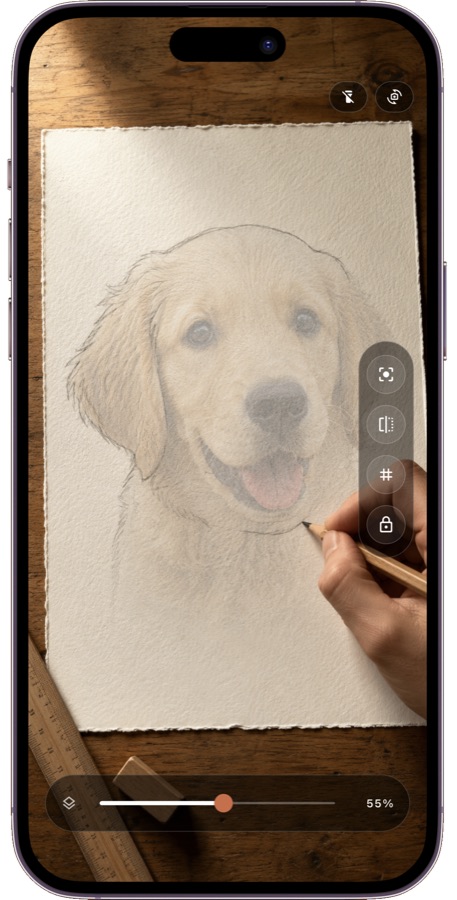
With a camera tracing app such as Tracely, you do not need a printout. Choose your pet's photo, prop the phone about 20 to 40 cm above the taped-down paper with the camera pointing straight down, lower the opacity until you see both the photo and the paper, then pinch and twist to size and place it. Turn on the 3x3 grid to check the proportions, tap Lock, and trace while watching the screen. It works on any paper thickness and at sizes larger than the phone.
What to trace, and what to leave out
Whichever method you use, keep the outline simple and light. A good pet outline includes:
- The outer edge of the head, ears and body, following where the fur changes direction rather than every tuft.
- The eyes: the outer shape, the pupil, and a small circle marking the highlight, which you will keep white.
- The nose and the line of the mouth.
- The edges of the big dark and light areas, such as a dark patch around one eye or a white chest.
- A few lines showing the main direction the fur grows.
Do not trace individual hairs or whiskers. Lines drawn while tracing tend to look stiff, and fur looks far more natural when you add it later by eye.
Step 3: Start with the eyes
The eyes carry the expression, so most pet artists finish them first. If the eyes look right, you will be motivated to finish the rest; if not, you can start over without losing much time.
- Leave the highlight as untouched white paper. It is much harder to get back with an eraser.
- Fill the pupil with your darkest pencil.
- Shade the iris with smooth layers, darker near the top where the eyelid casts a shadow.
- Darken the rim around the eye, then softly shade the fur around it so the eye sits inside the face rather than on top of it.
Step 4: Fur and shading
Squint at the photo. The details disappear and you see a few big areas of light, middle and dark. Shade those big areas first with light, even pencil, then build the fur on top.
- Draw fur with short strokes in the direction it grows, flicking the pencil off at the end so each stroke tapers.
- Work in layers, from light to dark. Short-haired pets need short, tight strokes; long-haired pets need longer, curving strokes in clumps.
- For white or light fur, draw the shadows between the hairs rather than the hairs themselves. The paper provides the white.
- For black fur, still leave subtle lighter areas where light hits the head and back, or it will look flat.
- Lift out light hairs and soft highlights with the pointed kneaded eraser.
For whiskers on a dark muzzle, a useful trick is to press the lines into the paper first with an empty ballpoint pen or a blunt tool. When you shade over them, the dents stay white and give crisp, thin whiskers.
Step 5: Finish and check
Step back from the drawing, or look at it in a mirror or through your phone's camera; fresh eyes spot problems. Strengthen the darkest darks, tidy the edges, and decide on the background. A simple soft shadow under the pet is often enough. Sign and date it.
New to tracing? Read the best way to trace for beginners for setup and troubleshooting tips, or how to trace a picture onto paper for more methods.
Frequently asked questions
How long does a pet portrait take?
A simple pencil sketch can take under an hour. A detailed portrait with full fur texture often takes several hours, spread over more than one sitting.
Can I draw my pet from a photo if I have never drawn before?
Yes. Get the outline right with a grid or by tracing, keep the shading simple, and focus most of your effort on the eyes. Your first attempt does not need to be perfect to be special.
Cat or dog: which is easier?
Short-haired pets with clear markings are usually easier than very fluffy ones, because the shapes are easier to see. Cats' faces are flatter and rounder; dogs vary much more, so look carefully at the length of the muzzle and the position of the ears.
Can I give or sell a drawing made from a photo?
If it is your own photo of your own pet, yes. If someone else took the photo, ask their permission first, especially if you plan to sell the drawing.